

Hydraulic bending machine helps expand business, improve processes.
Bending small parts on a traditional press brake can be challenging because it’s difficult to keep them square against the backstop. A 4-ft.-wide sheet is easy to square, but a narrow part will often wiggle left or right, says Matt Weeks, director of sales for Belcamp, Maryland-based Trilogy Machinery. “It’s really tough for the operator.”
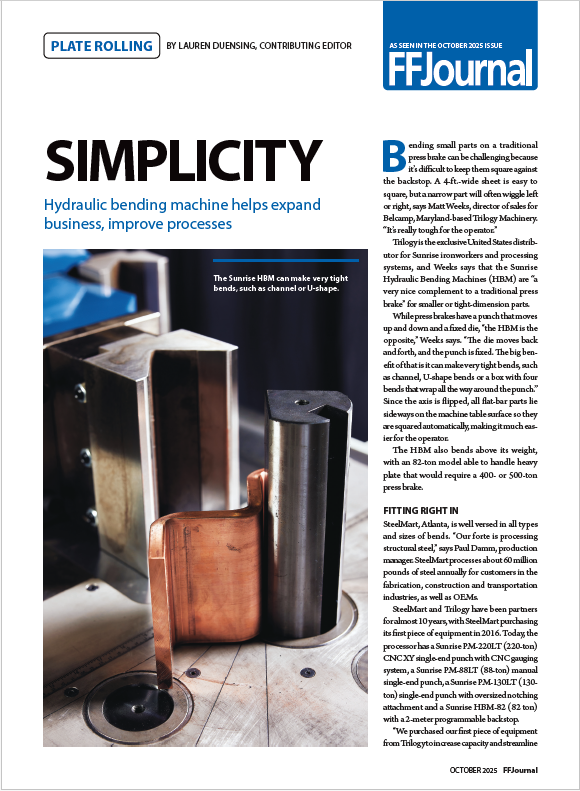
Trilogy is the exclusive United States distributor for Sunrise ironworkers and processing systems, and Weeks says that the Sunrise Hydraulic Bending Machines (HBM) are “a very nice complement to a traditional press brake” for smaller or tight-dimension parts. While press brakes have a punch that moves up and down and a fixed die, “the HBM is the opposite,” Weeks says. “The die moves back and forth, and the punch is fixed. The big benefit of that is it can make very tight bends, such as channel, U-shape bends or a box with four bends that wrap all the way around the punch.”
Since the axis is flipped, all flat-bar parts lie sideways on the machine table surface so they are squared automatically, making it much easier for the operator.
The HBM also bends above its weight, with an 82-ton model able to handle heavy plate that would require a 400- or 500-ton press brake.
Fitting Right In
SteelMart, Atlanta, is well versed in all types and sizes of bends. “Our forte is processing structural steel,” says Paul Damm, production manager. SteelMart processes about 60 million pounds of steel annually for customers in the fabrication, construction and transportation industries, as well as OEMs.
SteelMart and Trilogy have been partners for almost 10 years, with SteelMart purchasing its first piece of equipment in 2016. Today, the processor has a Sunrise PM-220LT (220-ton) CNC XY single-end punch with CNC gauging system, a Sunrise PM-88LT (88-ton) manual single-end punch, a Sunrise PM-130LT (130-ton) single-end punch with oversized notching attachment and a Sunrise HBM-82 (82 ton) with a 2-meter programmable backstop.
“We purchased our first piece of equipment from Trilogy to increase capacity and streamline a process,” says Damm, noting that SteelMart often chooses to develop new processes using manual equipment and then adds machines as needed to enhance production. In this instance, SteelMart was “plasma burning holes and then started getting into contracts that required no heat induction holes—they had to be either drilled or punched,” Damm says.
SteelMart started out drilling the holes, which took about a minute for each one. “But with the Sunrise punch, it’s just a few seconds. You square up the part, step on the pedal and it punches through.”
Game-Changer
After acquiring two more punches, SteelMart discovered the Sunrise HBM while researching how to improve the processing of custom column boots. “Initially, we were processing the column boots on our vertical press brake—a 10-in. column boot on a 12-ft. press,” Damm says. “We were not utilizing the capacity of that machine, and there were large orders that we could execute instead, so we needed to either free up this equipment or add additional capacity.”
The team at SteelMart has been working with Mark Skinner, vice president at Watson Hegner, for over 30 years, and Watson Hegner has been distributing Trilogy machines since 2009. “Mark brought Trilogy in and said he thought the Sunrise HBM would solve the problem,” Damm says, particularly because of the machine’s small footprint, which takes up less space than a traditional press brake. “It was definitely much more economical, just because of the size of the machine,” he adds.
Damm notes that the column boot originally started out as a two-part plate that was burned on the plasma table and then formed on the vertical press. The customer then was compelled to fit the two pieces together, tack weld and make minor adjustments before finally welding the two seams.
“Now, we have a fully formed box, and there is nothing for fitting because when it comes off of the bender, both the profiles line up,” Damm explains. “When the customer receives it, all they need to do is open up the gap to get the final dimension and fill the weld. So, not only did the Sunrise HBM reduce our internal costs, it improved the customer’s process time by 50 percent. It’s been game-changing for them.”
Can-Do Attitude
Sunrise HBMs are available in either 45 or 82 tons with an 8 in. by ½ in. or 12 in. by ½ in. capacity and offer a wide range of tooling, including custom options, for different types of bending operations. The equipment has a digital linear encoder and proximity sensors to achieve stroke repeatability, a programmable touchscreen controller with a 50-program memory, and an included manual back gauge for accurate positioning.
Damm says that SteelMart usually says yes to customer requests, which sometimes necessitates reaching out to Trilogy to receive recommendations on the limitations of the equipment.
“It’s a great relationship. We call on them whenever we have an obstacle that we’re not able to resolve and work together to figure it out.”
Simple but Effective Operation
With Trilogy, SteelMart has been able to reverse engineer some additional parts for existing customers and reduce the processing time on parts that were coming off the vertical press in two pieces, similar to the column boot. “We have evolved from just doing channels and squares as well, and we’re even putting rounds in the punches to utilize ‘bump rolling’ for a faster turnaround time than roll forming,” Damm says.
The HBM’s straightforward operation not only allows SteelMart to optimize part production but also repurpose employees as necessary to get jobs done. Weeks says that the HBM is “very simple” compared to a traditional press brake’s CNC programming software, “almost like a PLC-based interface. There’s no tooling library. Operators simply set the depth of stroke from the movement of the ram. It’s much easier for an inexperienced operator to pick up—and operators with experience take to it even faster.”
“My crane operators sometimes have free time within their day,” adds Damm. “If they don’t have a customer delivery or a piece of equipment that they’re staging for, they may find themselves with a half hour here, a half hour there. The forming manager has trained all the crane operators on the HBM.”
“We have a couple of small parts that we do repetitively stored in the machine’s library. Once it’s set up, it’s programmable. The crane operators call the part up out of the library, put the parts in there, start stepping on the pedal and making parts. It’s a very simple piece of equipment—but very effective.”